
For a long time, a good part of CRM consulting was knowing where things were. Which setting turns on duplicate detection, how to add a column to a view, where a security role's privileges live. That knowledge took years to build, and customers paid for it.
That part of the job is now being automated, and quickly. We think that's a good thing. It will also make it much clearer which consultants were adding value and which were mostly finding their way around screens.
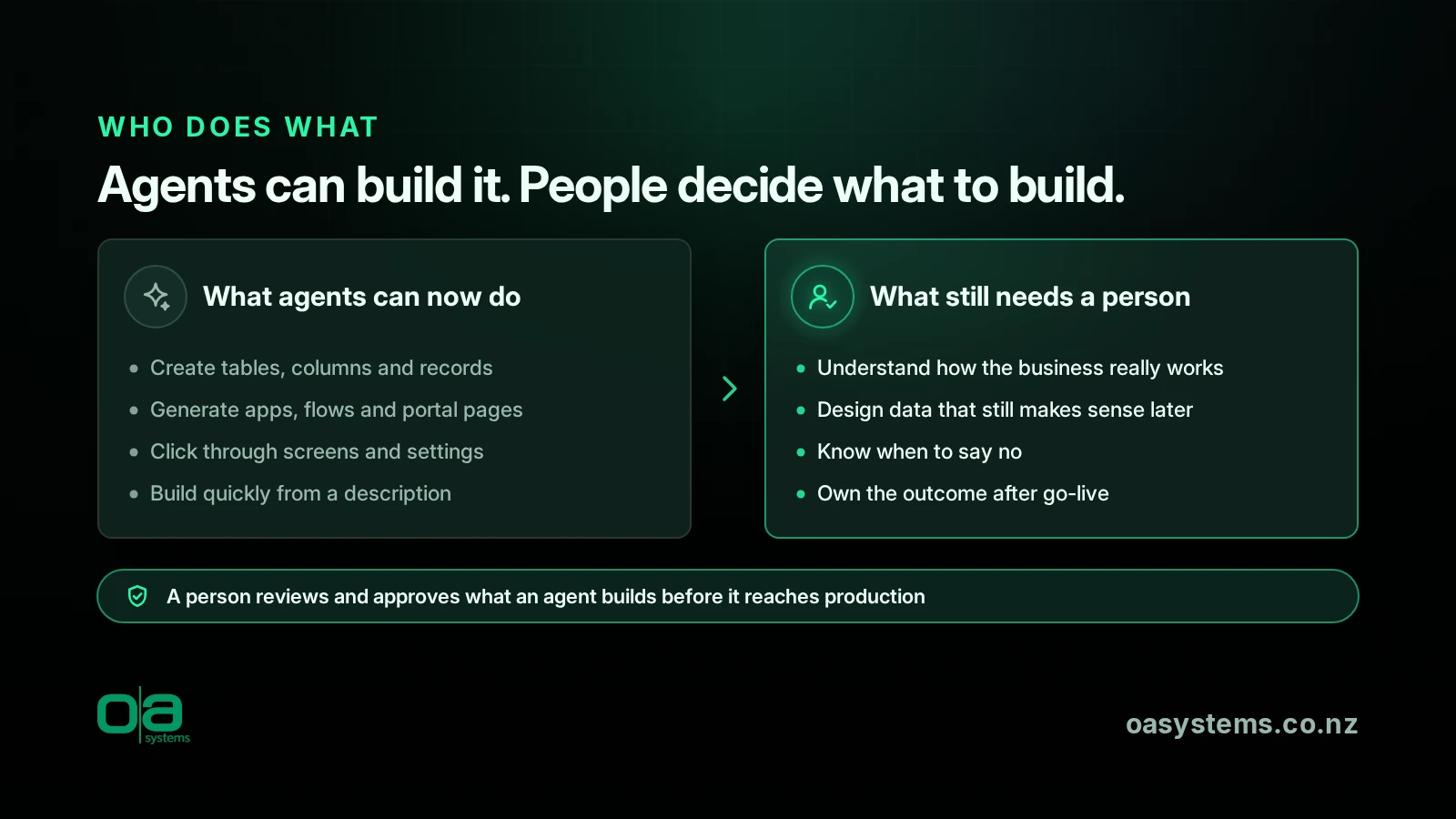
What agents can already do
This isn't a prediction. The tools are already here.
- Plans in Power Apps lets you describe a business use case in plain language and get a generated Power Platform solution. According to Microsoft Learn, that includes Dataverse tables, canvas and model-driven apps, Power Pages sites, Power Automate flows and Copilot Studio agents. It's generally available and on by default.
- The Dataverse MCP server gives AI clients such as Copilot Studio, GitHub Copilot and Claude tools including
create_table,update_table,create_recordandupdate_record. So an agent can change the schema as well as the data (Microsoft Learn). - Computer use in Copilot Studio lets an agent work websites and desktop apps by selecting buttons, choosing menus and typing into fields. Microsoft's documentation puts it simply: "If a person can use an app or website, computer use can too."
Put those together and an agent can do much of the mechanical work of configuring a CRM from a description. Not perfectly, and not without review, but well enough that charging days for it will get harder to justify.
What agents can't do for you
The question an agent can't answer well is the one that comes before the build: what should we build at all?
Understanding the business. An agent will happily build exactly what you describe. But many CRM problems don't start with poor configuration. They start with a description that was wrong or incomplete: a sales process that only works on paper, a status field that means different things to different teams, or a requirement that's really a workaround for a problem somewhere else. Finding that out means sitting with people and asking why. That's still human work.
Designing the data. Tables are easy to create. A data model that still makes sense in five years isn't. Should a membership be its own table or a set of fields on the contact? Which data belongs in the CRM, and which should stay in the finance system? These decisions are cheap to get right early and expensive to change later. An agent that can create ten tables in a minute just gets you to a poor design sooner. Good Dataverse design matters more when building is quick, not less.
Knowing when to say no. This is the most underrated skill in CRM consulting. No to the custom field that duplicates one that already exists. No to the approval step nobody will use. No to automating a process before people have agreed what the process is. Agents are built to complete tasks. A lot of a system's long-term health comes from the tasks someone talked you out of.
Owning the outcome. Microsoft's own implementation guidance makes this point. Its Success by Design framework now builds agentic design principles into every phase of a project, but it's clear that this "doesn't remove human accountability". In Microsoft's words, implementation teams "remain responsible for validating agent outputs, defining agent scope and data access, and maintaining oversight throughout the project lifecycle."
What this means if you're buying consulting
If you're choosing a partner for a new Dynamics 365 implementation or to improve an existing system, ask less about how quickly they can configure things, and more about:
- How they find out what you actually need. Do they start with your processes and outcomes, or with a feature list?
- How they design the data model. Can they explain, in business terms, why a table is structured the way it is?
- What they'd leave out. A good consultant should be able to tell you what they'd advise against, and why.
- How they use agents themselves. Using AI to build faster is sensible. Using it without review, on your production data, isn't.
- Who stays accountable. If an agent built part of the solution, who checked it, and who owns it after go-live?
What it means for consultants
For consultants, the honest answer is that some work is going away. Clicking through settings was never the valuable part, even when it was billable. The skills that remain are the ones that were always hardest to learn: understanding how an organisation really works, turning that into a sound design, explaining trade-offs to people who aren't technical, and having the judgement and confidence to push back.
We think that's a better job. It's certainly the one we'd rather do. It's why our consulting and solution design work starts with the business rather than the platform.
The bottom line
Agents will do more and more of the building. That makes the thinking more valuable, not less. The consultants who do well will be the ones who were always valued for what they understood, not for knowing where to click.
Frequently asked questions
Can AI agents really build a Dynamics 365 or Power Platform solution?
They can build a lot of it. Microsoft's Plans in Power Apps generates Dataverse tables, apps, Power Pages sites, flows and agents from a plain-language description, and the Dataverse MCP server lets agents create and update tables and records. The results still need review by someone who understands the business and the data.
Does that mean we'll need fewer consultants?
You may need fewer hours spent on configuration. You're unlikely to need less of the work that decides what to build: understanding processes, designing the data model and deciding what to leave out. That's the work with the biggest effect on whether a system is still useful in a few years.
Is it safe to let agents change our CRM?
It can be, with the right controls. Treat an agent like a new integration with its own permissions, test in a non-production environment, and keep a person responsible for approving changes. Microsoft's Success by Design guidance says implementation teams remain accountable for validating agent outputs and defining agent scope and data access.
What should we ask a CRM partner about AI?
Ask how they work out what you need, how they design data, what they'd advise against, and how they review work done by agents.
Talk to OA
If you'd like a partner who asks the awkward questions before anything gets built, have a look at how we help, or start with a conversation about Dynamics 365 consulting and solution design. If you're thinking about agents specifically, our AI adoption and Copilot enablement service is a good place to start.